
Material Guides
What Is Denier Fabric? 600D, 900D & 1680D | Racquet Bag
Learn what denier fabric means and compare 600D, 900D and 1680D in durability, weight, water resistance and applications for bags.
On this page
Overview / Beyond the D number
Denier Fabric Overview
“Denier fabric” is convenient shorthand for a textile identified by its yarn rating. A bag catalog might list 600D polyester, 900D nylon or 1680D ballistic nylon. These descriptions combine a yarn measurement with other material information; they are not interchangeable quality grades.
D ratings are common in luggage, sports bags, backpacks and outdoor equipment because buyers need a shared way to describe shell yarns. However, the same denier can appear in fabrics with different weave densities, finishes and handling characteristics.
| Term | Meaning | Why it matters |
|---|---|---|
| Denier (D) | Yarn mass per 9,000 meters | Describes yarn linear density |
| GSM | Finished fabric mass per square meter | Helps estimate material weight |
| Weave | How yarns interlace | Influences structure and durability |
| Fiber type | Polyester, nylon or another fiber | Changes strength, feel and moisture behavior |
| Coating | PU, PVC, TPU or another layer | Changes water resistance, stiffness and function |
| Abrasion resistance | Measured wear performance | Checks suitability for repeated friction |
Compare actual samples under compatible test conditions. Denier does not measure finished-fabric thickness, area weight or waterproof performance, and a familiar label cannot replace a complete specification.
What Does Denier Mean in Fabric?
Denier expresses how much a known length of yarn weighs. Imagine equal lengths of three yarns laid out without stretching: the one with the greatest mass has the highest denier. The measurement concerns yarn, before considering how much of it goes into a fabric panel.
How Is Denier Calculated?
Denier (D) = Yarn Mass in Grams × 9,000 / Yarn Length in Meters
| Yarn rating | Mass over the same length |
|---|---|
| 600D | 600 grams per 9,000 meters |
| 900D | 900 grams per 9,000 meters |
| 1680D | 1,680 grams per 9,000 meters |
For example, a 900-meter yarn sample weighing 60 grams calculates to 600D. These figures are masses of yarn lengths, not weights of one square meter of cloth. The same mass-per-length concept is also expressed through related yarn numbering systems such as tex.
A denier value can describe a multifilament bundle containing many smaller filaments. A 1680D yarn is not necessarily one enormous fiber. Also check whether a supplier specifies the same yarn in the warp and weft, or different ratings in each direction.
Does Higher Denier Mean Thicker Fabric?
Greater linear density often corresponds to coarser yarn when fiber and yarn construction are similar. Finished thickness also depends on filament shape, twisting, weave, compaction and finishing. A coating can add thickness without changing the underlying yarn rating. Handle and measure the finished cloth when bulk matters.
600D vs 900D vs 1680D Fabric
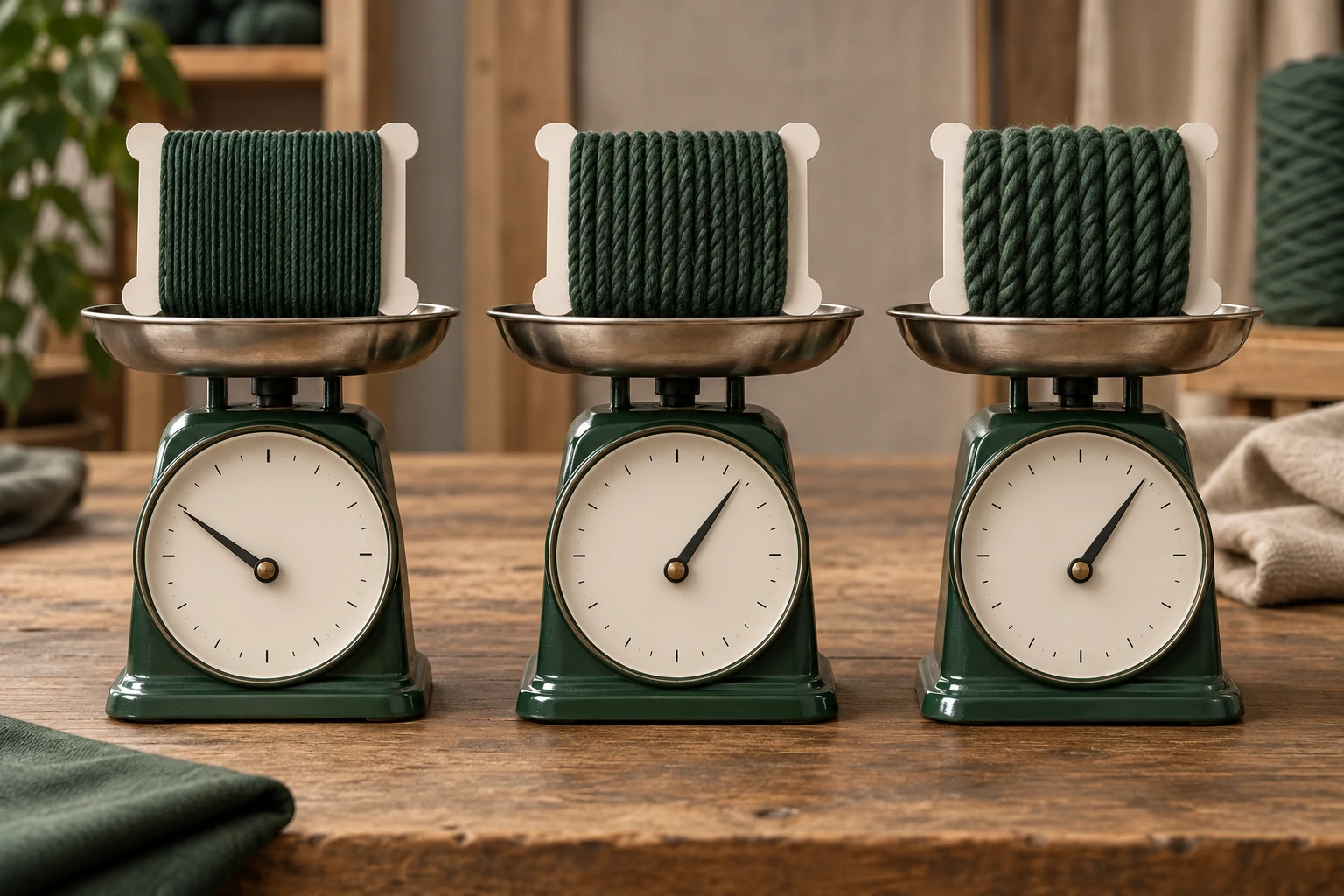
600D, 900D and 1680D identify increasing yarn linear mass. They commonly appear in everyday, more demanding and heavy-duty bag constructions respectively. That progression is useful for shortlisting materials, but does not establish a universal ranking of fabric quality.
| Feature | 600D | 900D | 1680D |
|---|---|---|---|
| Relative yarn linear density | Lower | Intermediate | Highest of these three |
| Typical positioning | Everyday | More demanding use | Heavy-duty |
| Fabric weight* | Often lighter | Often intermediate | Often heavier |
| Flexibility* | Often more flexible | Moderate | Often firmer |
| Abrasion potential* | Regular use | Frequent use | Demanding wear |
| Relative cost* | Often economical | Often mid-range | Often higher |
| Common applications | Gym bags, school bags, promotional backpacks | Travel backpacks, sports duffels, reinforced panels | Luggage, protective cases, equipment bags |
*These are tendencies for otherwise comparable fibers and constructions, not specifications or measured results. Coatings, yarn quality and weave can change or reverse the comparison.
What Is 600D Fabric?
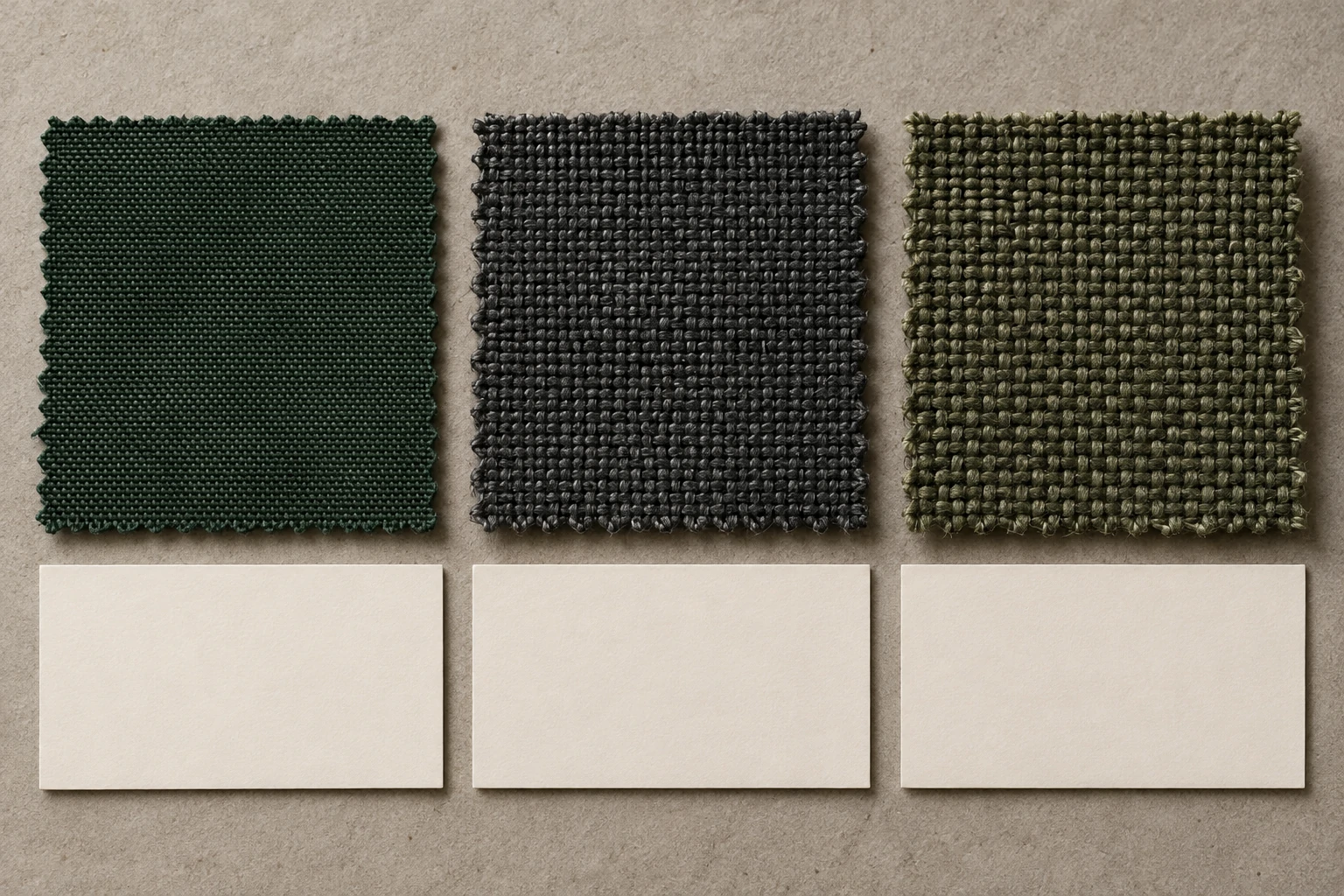
600D fabric uses yarn rated at 600 grams per 9,000 meters. Polyester and nylon versions exist, with different constructions and finishes. The label is common in gym bags, school backpacks, sports bags and promotional products that balance everyday handling, cost and decoration requirements.
- Compare coated and uncoated versions for the required function.
- Check print, embroidery and label compatibility on the actual finish.
- Reinforce corners or bases that encounter repeated rough contact.
For OEM sports bags, 600D can be a useful starting point without excessive shell mass. Repeated dragging or concentrated equipment contact may expose its limitations in a particular construction. Our 600D polyester guide examines those applications in more detail.
What Is 900D Fabric?
900D fabric describes yarn with an intermediate linear mass between 600D and 1680D. It is often considered for travel bags, frequently used sports duffels and panels needing a firmer hand. Both polyester and nylon choices should be evaluated against the same intended use.
A 900D base or end panel may provide useful structure without using heavy cloth everywhere. Added weight and expense still need justification. Compare abrasion results, finished GSM and the sewn sample; “900D” alone does not prove an improvement over a well-specified 600D fabric.
What Is 1680D Fabric?
1680D fabric uses yarn rated at 1,680 grams per 9,000 meters. Common applications include heavy-duty luggage, equipment bags, protective cases and reinforced bottoms. Its substantial construction may suit wear zones, but added rigidity, mass and sewing complexity can be disadvantages.
1680D polyester and 1680D ballistic nylon are distinct materials. Ballistic nylon describes a fabric family associated with rugged nylon constructions, often basketweaves; it is not a synonym for every 1680D textile. Inspect the weave, coating and test evidence. Read the ballistic nylon guide for that distinction.
How Does Denier Affect Fabric Performance?
Yarn denier contributes to a fabric’s construction, but performance emerges from the finished material and its use. Treat the D number as one input when comparing samples.
Abrasion Resistance and Durability
Abrasion is wear from repeated rubbing: a duffel sliding on a floor, luggage corners contacting conveyors, or equipment moving against a bag wall. Yarn texture, weave, finish and coating affect the outcome. Denier cannot predict Martindale cycles or translate laboratory results into years of service.
Tear and Tensile Strength
Tear resistance concerns propagation of an existing cut. Tensile testing measures response to pulling, including breaking force under a specified setup. Puncture resistance addresses penetration by a point. Yarn quality, weave and loading direction influence each differently; one result cannot stand in for all three.
Weight and Flexibility
A substantial shell can support a structured silhouette, especially with appropriate lining and foam. That same stiffness may make pocket corners difficult to sew or add uncomfortable weight to a frequently carried racket bag. Compare a loaded prototype, not just a flat swatch.
Cost and Product Positioning
Cost depends on material specification, fabric consumption, usable width, cutting waste and manufacturing complexity. Heavy layers can complicate turning and stitching. Mixed-denier panels may direct spending toward actual wear zones while preserving a lighter body, optimized through prototype evaluation.
Comparison checklist: abrasion method and endpoint; tear direction; tensile method; flexibility; finished GSM; coating adhesion; and complete material and assembly cost. Record the same conditions for each candidate so the comparison remains useful.
Denier vs GSM: What Is the Difference?
Denier measures yarn mass per length; GSM measures fabric mass per area. The units answer different purchasing questions and cannot be converted directly without knowing the fabric construction.
| Criterion | Denier | GSM |
|---|---|---|
| Unit | Grams per 9,000 meters | Grams per square meter |
| Measures | Yarn linear mass density | Fabric area mass |
| Example | 600D yarn | 250 GSM = 250 g/m², illustrative only |
| Limitation | Does not give finished fabric weight | Does not identify yarn or strength |
| Sourcing use | Specify warp and weft yarns | Estimate panel weight and check consistency |
Two fabrics labeled 600D can have different GSM because one uses more yarns per unit area, a different weave or a heavier backing. Conversely, a loosely constructed higher-denier fabric could weigh less per square meter than a densely woven, heavily coated lower-denier fabric.
For a weight estimate, multiply fabric area in square meters by measured GSM. That gives panel material mass before adding lining, zippers, foam, binding and hardware. Ask whether the reported GSM includes coating, and agree a tolerance and conditioning method rather than assuming a universal range.
GSM becomes especially useful when comparing alternate bag shells. A purchasing team can estimate the difference in fabric mass across a pattern, then decide whether extra structure belongs in every panel or only in the base and corners. It still does not confirm durability on its own: a fabric with the same GSM may have a different fiber, coating distribution or weave density. Keep the reported GSM with the approved swatch so later substitutions are easier to identify.
Nylon vs Polyester Denier Fabric
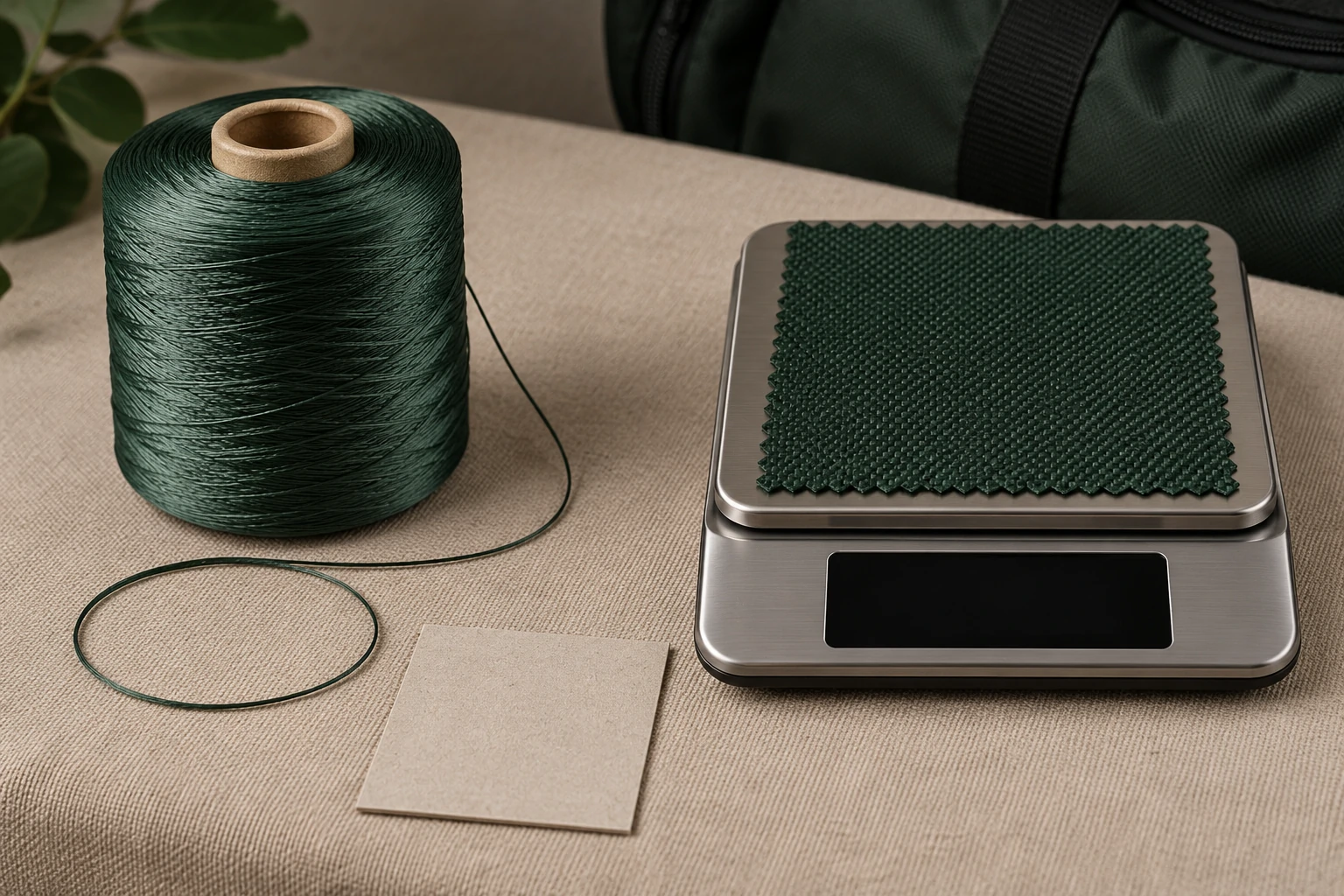
Matching D values establish matching nominal yarn linear mass, not identical fiber properties. Polymer grade, filament construction, yarn processing and finishing can make two 600D fabrics behave differently.
| Criterion | Polyester | Nylon |
|---|---|---|
| Strength-to-weight | Depends on grade and construction | Often favorable for demanding uses |
| UV and color retention | Generally favorable; verify dye and finish | Depends on formulation and finish |
| Moisture absorption | Generally lower | Generally higher |
| Abrasion behavior | Construction-dependent | Often favorable in comparable technical constructions |
| Cost | Frequently economical | Frequently more expensive |
| Applications | Promotional, everyday and travel bags | Technical, outdoor and protective gear |
These are selection tendencies, not material grades or guarantees. A coating can dominate water penetration, stiffness and surface wear. Moisture absorbed by a fiber is also different from rain leaking through a woven opening or seam.
Compare actual dyed and finished samples for color transfer, hand and decoration compatibility. A nylon upgrade may offer useful performance, but its value must survive the complete bag’s weight and cost constraints. See nylon versus polyester for sports bags for the broader sourcing comparison.
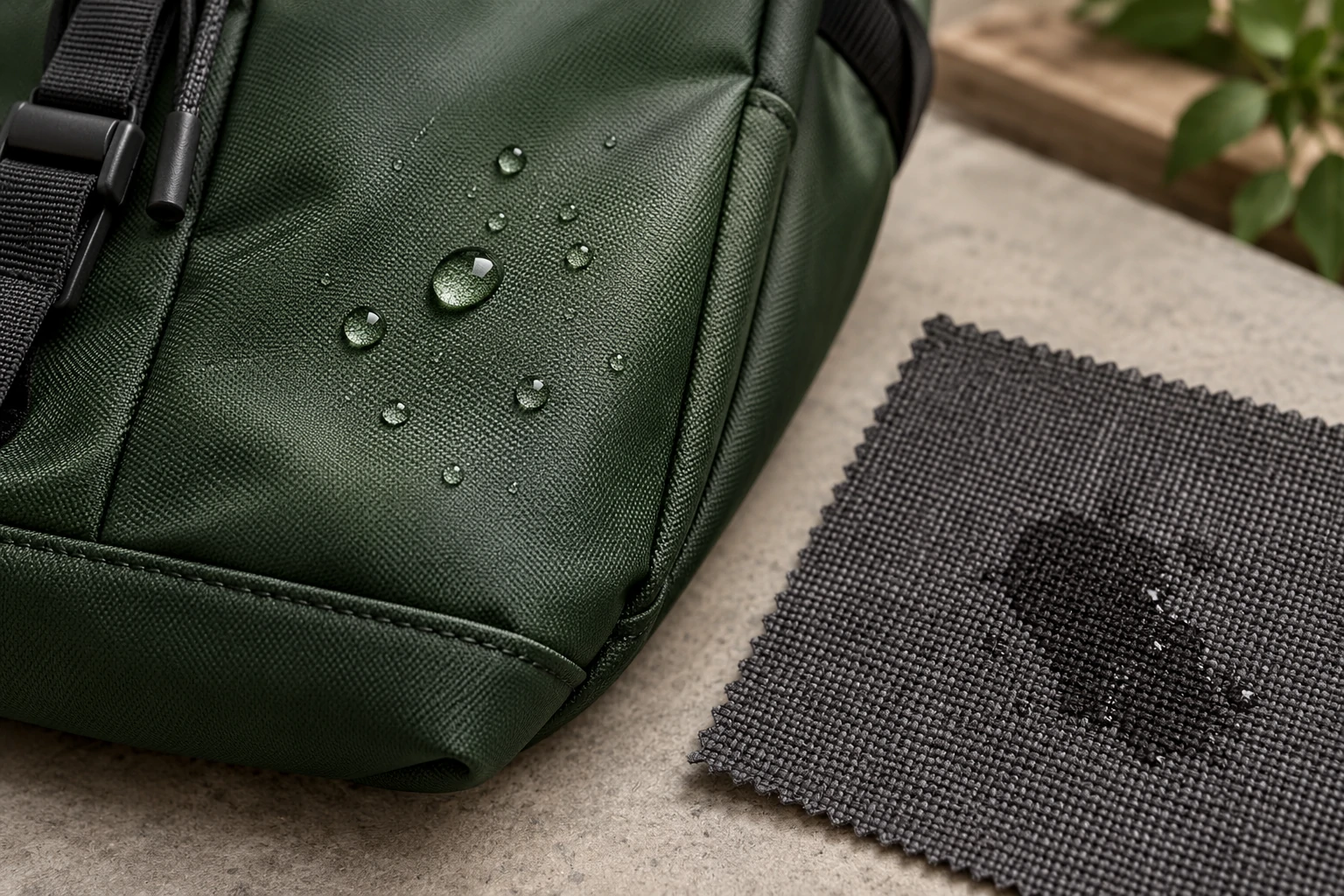
Is Higher Denier Fabric Waterproof?
No. Denier alone establishes neither water resistance nor waterproofness. High-denier uncoated fabric can still admit water through gaps between yarns. A tightly woven structure may influence penetration, but a D label is not a barrier specification.
PU or PVC coatings and TPU coating or lamination systems can change water resistance. Their continuity, thickness, adhesion and condition matter. A water-repellent finish helps surface droplets bead; it does not necessarily prevent water passing through under pressure.
| Feature | What determines it |
|---|---|
| Water repellency | Surface treatment |
| Hydrostatic resistance | Coating or membrane and tested construction |
| Leak resistance | Seam sealing, zipper and closure design |
| Durability | Fabric and coating quality under use |
Stitch holes, seams and zippers can bypass an effective fabric barrier. A waterproof bag claim therefore requires appropriate complete-product construction and evidence for the intended exposure. A water-resistant bag may handle limited rain without being suitable for immersion.
ISO 811 measures fabric resistance to water penetration using hydrostatic pressure. That result describes a defined test, whereas “1680D” describes yarn. Our waterproof versus water-resistant guide explains why those claims require separate assessment.
Which Denier Fabric Is Best for Different Bags?
The best choice meets the product’s handling, protection and carrying requirements at an acceptable weight. The directions below are illustrative starting points for sample evaluation, not compulsory specifications or guaranteed performance levels.
For high-capacity tournament racquet bags and travel duffels, a combination of 900D polyester on the main body with 1680D ballistic nylon on high-friction bottom corners offers the best balance of weight and ruggedness. Explore our full range of custom sports bags to review how our factory applies different denier fabrics to active product lines.
| Bag type | Starting material to evaluate | Key decision |
|---|---|---|
| Promotional gym bag | 300D–600D polyester | Budget and branding |
| Daily backpack | 420D–600D polyester or nylon | Comfort and everyday durability |
| Pickleball backpack | 600D–900D polyester | Paddle storage, weight and abrasion |
| Tennis racket bag | 600D–900D with optional reinforcements | Protection, weather and carry comfort |
| Travel sports duffel | 900D or reinforced 600D | Repeated handling and structure |
| Heavy-duty equipment bag | 900D–1680D, design-dependent | Abrasion, load and weight |
| Luggage or tool bag | 1680D or mixed-denier construction | Wear zones and structural durability |
For racket sports, padding and compartment geometry protect frames and paddle faces; denier does not replace either. Check shoulder straps, grab handles and zipper access with the expected equipment load. Separate wet shoes or clothing where the product brief requires it.
Why Mixed-Denier Construction Can Be Practical
A 600D body with a 900D or 1680D base can put a heavier material where ground contact occurs. Check seam compatibility, needle damage, stiffness transitions and visual consistency between panels. A reinforcement that makes the bag awkward to fold or creates a weak join may defeat its purpose.
How to Choose the Right Denier for Custom Bag Manufacturing
Define the Intended Use
Describe the load, carrying duration, abrasion areas, weather exposure and retail positioning. Identify whether the bag spends more time on a shoulder, a court floor or in transport. These conditions guide material selection more effectively than requesting the highest available denier.
Compare Fabric Specifications
Record fiber composition, warp and weft denier, weave, finished GSM, coating type, required water resistance, colorfastness and acceptable tolerances. Include finish and color references. A supplier’s shorthand product name is useful for identification but should not replace these agreed details.
Request Samples and Test Reports
Approve swatches, then assess a sewn prototype. Reports should identify the sample, conditioning, method, units and acceptance criteria. Check coating adhesion and relevant abrasion, tear and tensile behavior separately from finished-bag handle, seam and closure performance.
ISO 12947-2 assesses Martindale specimen breakdown for applicable textiles and excludes coated or laminated fabrics; coated surfaces require an appropriate ISO 5470 method. ASTM D2261 addresses tongue tear, while ASTM D5034 addresses grab breaking strength and elongation.
Balance Performance and Cost
Specifying 1680D throughout a lightweight pack can add unnecessary mass and sewing difficulty. Under-specifying a frequently dragged base can shorten useful life. Compare the complete bill of materials and prototype behavior before deciding where heavier fabric is justified.
- End-use and target market defined
- Fiber composition confirmed
- Denier and weave verified
- GSM and finishing described
- Relevant performance tests agreed
- Color and branding compatibility checked
- Wear zones reinforced appropriately
- Approved pre-production sample retained
Common Misconceptions About Denier Fabric
Use the label to begin the specification conversation. These common shortcuts can lead to unsuitable materials when they replace sample review.
| Myth | Fact |
|---|---|
| Higher denier always means stronger fabric. | Fiber type, weave, finish and tests establish actual performance. |
| 1680D fabric is automatically waterproof. | Water protection depends on coating, seams and construction. |
| 600D nylon equals 600D polyester. | Matching yarn linear density does not match physical properties. |
| Denier and GSM are interchangeable. | One measures yarn mass per length; the other, fabric mass per area. |
| Every 1680D fabric is ballistic nylon. | 1680D polyester and ballistic nylon are different descriptions. |
| The highest denier is the best purchase. | Match load, handling, weight target and budget. |
How to Read a Supplier Fabric Data Sheet
A useful data sheet identifies more than a D rating. Start with the fiber composition and whether the stated denier applies to warp, weft or both. Then read the weave or construction description, finished GSM, width, backing, coating and color reference. These details show what the material actually is, rather than just how a catalog names it.
Performance results need their own context. A report should name the method, sample orientation, conditioning, exposed face and failure or endpoint criterion. An abrasion number without the method is difficult to compare. A water result without whether the coating was tested, or whether a complete sewn bag was tested, can lead to an overbroad marketing claim.
Why Direction and Assembly Matter
Woven fabrics can respond differently along warp and weft directions. A reinforcement panel may be oriented to resist a known pull or rub direction, but the seam joining it is still a separate design decision. Needle size, stitch density, binding, seam allowance and hardware attachment can become the limiting factors in a finished bag.
Consider the whole use sequence. A tennis bag carried to court encounters shoulder loading, zipper cycles, racket-frame contact and occasional floor abrasion. A rolling equipment bag has corners, wheel housings and handles that experience different forces. Recording those events helps specify targeted reinforcements instead of simply increasing denier across every panel.
Keep Comparisons Like for Like
Request samples in the intended color and finish, because dye, coating and surface texture can alter the result. Compare equal panel sizes and prototype details when estimating carry weight. If a material change is made after sample approval, identify what changed and decide whether the relevant checks should be repeated. This creates a clearer record for purchasing teams and avoids treating one acceptable swatch as proof for every future material lot.
Clear answers / Better specifications
Frequently Asked Questions About Denier Fabric
What does denier mean in fabric?
Denier is the mass, in grams, of 9,000 meters of yarn. On a fabric label it usually identifies a yarn specification, sometimes with separate warp and weft values. It does not tell you the finished cloth’s area weight, thickness, strength or coating performance without additional information.
What is the difference between 600D and 900D fabric?
900D yarn has greater mass per equal length than 600D yarn. In comparable bag constructions, 900D may provide a firmer, heavier shell suited to more frequent handling. The actual improvement, if any, depends on fiber, weave and finish, so compare complete specifications and relevant sample results.
Is 1680D better than 600D?
1680D is better only when its particular construction suits the job. A heavy equipment base may benefit from a substantial fabric, while a commuter or promotional bag may prioritize lower weight and easier handling. Evaluate the finished bag’s weak points rather than assuming the largest number is the best choice.
Is higher denier always stronger?
No; higher denier describes more yarn mass per length, not a guaranteed strength increase. High-quality lower-denier yarn and an appropriate weave can outperform a poorly specified heavier construction in a particular test. Compare tear and tensile results separately, including direction, conditioning and the exact test method used.
Is 600D polyester good for backpacks?
600D polyester can suit many everyday backpacks when its construction matches the load and use. Check the coated fabric, base, shoulder-strap anchors, seams and zippers together. A satisfactory shell cannot compensate for weak assembly, and frequent rough handling may justify additional reinforcement or a different material specification.
Is 900D fabric suitable for sports bags?
900D is a reasonable candidate for frequently used sports bags, especially when structure or repeated contact is a concern. Confirm whether it is polyester or nylon and review its finished weight and coating. A reinforced base may be more useful than increasing the denier of every panel.
What is 1680D ballistic nylon?
1680D ballistic nylon is a heavy nylon textile described by its yarn denier and ballistic-style construction, commonly a basketweave. Confirm the nylon type, yarn arrangement, weave and backing because products vary. The historical name does not make ordinary bag fabric bulletproof or establish a protective-equipment rating.
Is 1680D polyester the same as ballistic nylon?
No. Polyester and nylon are different polymers, even when their yarns share a 1680D rating or their weaves look similar. A polyester fabric may be marketed as ballistic-style, but that does not make it nylon. Require explicit fiber content and construction details when approving or substituting materials.
Is high-denier fabric waterproof?
High denier does not make fabric waterproof. Water can pass through an uncoated weave regardless of the yarn number. A coating or laminate may resist penetration through a panel, while sewn openings and closures still need attention. Ask for water-test conditions that reflect the intended exposure and assembled product.
What is the difference between denier and GSM?
Denier measures yarn mass over a stated length; GSM measures fabric mass over a stated area. They are complementary specifications. A coating or denser weave can raise GSM without changing yarn denier. There is no direct conversion unless the necessary construction details are also known and accounted for.
Which denier is best for pickleball and tennis bags?
600D–900D fabrics are useful starting candidates for many pickleball and tennis bag designs, with heavier panels considered where wear concentrates. They are not universal requirements. Balance loaded carry comfort, equipment protection, pocket layout, weather exposure and abrasion, then approve a representative prototype with the intended racket or paddle load.
How can I verify denier fabric quality before bulk ordering?
Verify quality through an agreed specification, identified swatches, relevant test reports and an approved sewn sample. Confirm fiber, warp and weft denier, weave, finished GSM, coating and color. Compare test conditions and acceptance criteria, and retain the approved reference so subsequent material deliveries can be checked against it.
Make the material fit the bag
Choosing the Right Denier Fabric
600D is a practical candidate for many economical everyday bag projects. 900D may suit more demanding sports and travel applications, while 1680D deserves consideration for selected heavy-duty products and wear zones. Each direction still needs a defined construction and sample review.
| Priority | Fabric direction to evaluate |
|---|---|
| Economy and everyday use | 600D |
| More demanding general use | 900D |
| Heavy-duty wear zones | 1680D |
| Optimized weight and cost | Mixed-denier design |
Fiber type, weave, GSM, finish and test results are more useful than denier alone when predicting suitability. Mixed-denier construction can balance reinforcement with carrying weight, provided the panel joins and complete bag perform as intended.
For a custom sports bag, racket bag or travel bag, use the intended load and exposure to frame a discussion about material options and sample requirements.
Your next bag project
Ask About Denier Fabric Selection for Custom OEM Bags
As a specialized sports and racquet bag manufacturer, Racquet Bag provides direct technical consultation on yarn denier, tensile ratings, and PU backing thicknesses. Whether your brand requires 600D promotional bags, 900D club collections, or 1680D pro bags across our wholesale racquet bag catalog, including tennis racquet bags and pickleball bags, our factory delivers precision private-label manufacturing with low factory MOQ. Request our complimentary denier swatch book and quote.
Prefer email? Send your project brief.