
Sports Bag Guides
Duffel Bag vs Backpack for Sports Guide | Racquet Bag
Compare duffel bags vs backpacks for sports by capacity, comfort, gear access, commuting, shoe storage, gym use and team sports to find the right option.
On this page
Overview
Duffel Bag vs Backpack at a Glance
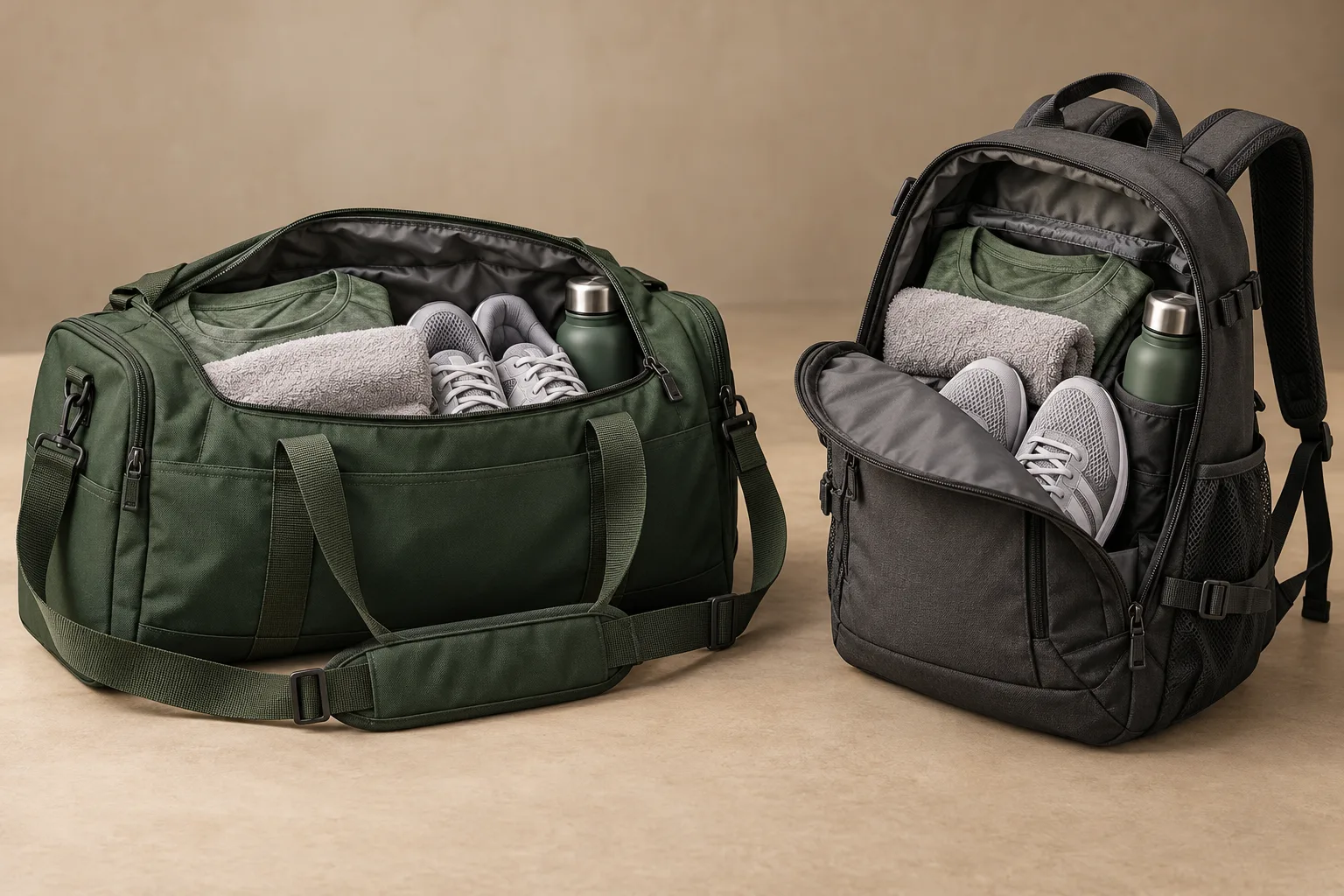
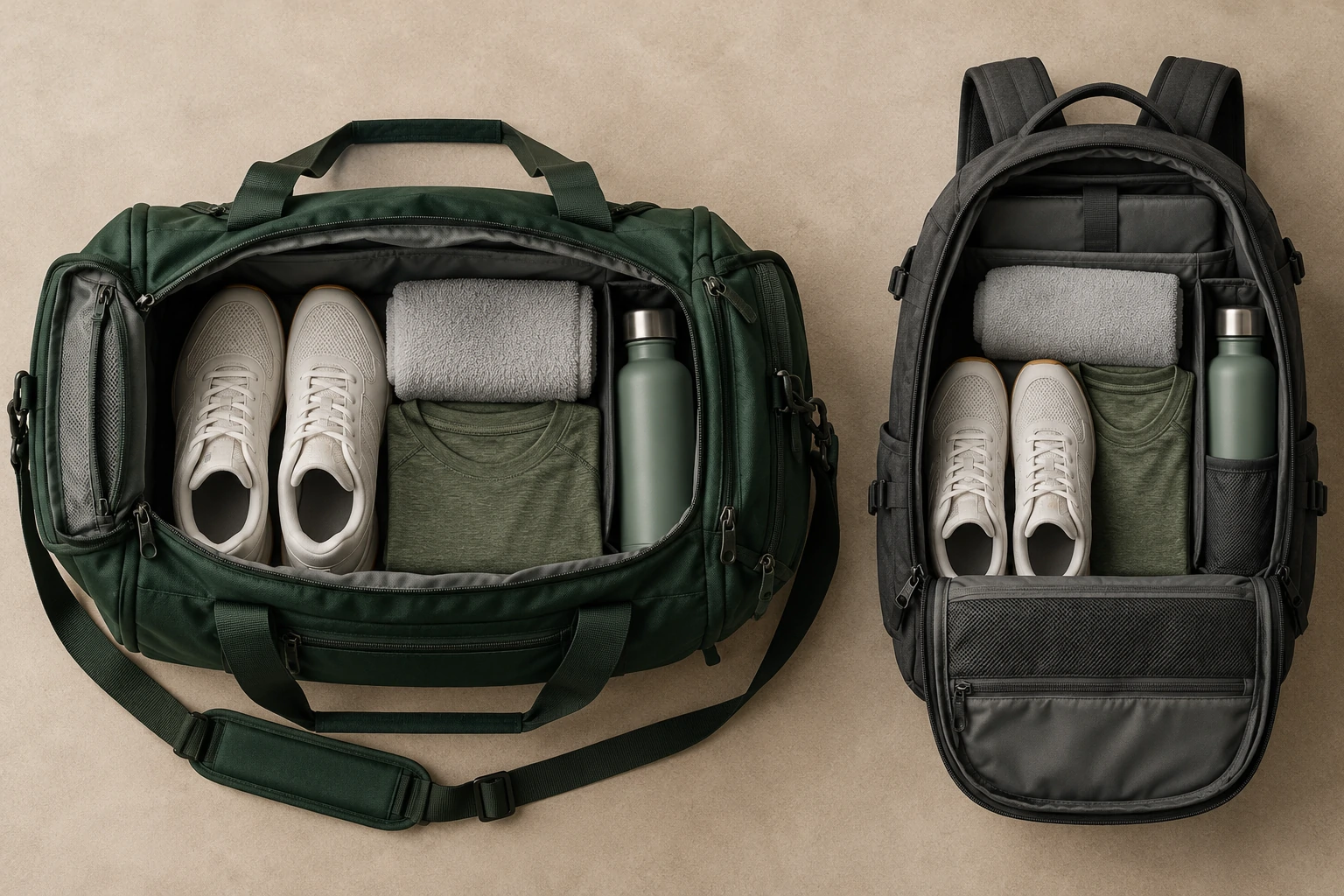
A sports duffel bag is built around a horizontal body, a wide zipper opening, grab handles, and usually a shoulder strap. Its large central cavity can accept shoes, folded clothing, towels, balls, and awkwardly shaped equipment without forcing each item into a narrow channel. Sports duffels may add end pockets, a shoe tunnel, or a wet compartment, but the main value is flexible packing space.
A sports backpack uses a vertical body, two shoulder straps, and a back panel that holds the load close to the body. It commonly has internal organizers, bottle pockets, and, in commuter models, a laptop sleeve. Specialized sports backpacks may also include shoe storage. Shape matters as much as stated liters: a duffel's open cavity makes irregular gear easier to pack, while a backpack's structure makes a load easier to carry while moving.
The choice usually comes down to five questions:
- How much equipment do you carry?
- How far do you carry the bag?
- Do you walk, cycle, drive, or use public transport?
- Do you need fast access to your gear?
- Do shoes and wet clothing need separate storage?
The comparison
What Is a Sports Duffel Bag?
A sports duffel bag is a horizontal bag designed around accessible, flexible storage. A long zipper often opens across the top, so an athlete can see most of the main compartment at once. The format is practical when a load includes items that do not stack neatly: football boots, basketball shoes, boxing gloves, lifting belts, towels, knee pads, team uniforms, or rackets in an appropriately shaped sports duffel.
Most sports duffels range from 30 to 70 liters. As a professional sports bag manufacturer, our factory crafts specialized designs such as tennis duffel bags and padel duffel bags featuring isolated ventilated footwear tunnels, thermal racquet sleeves, and heavy-duty water-resistant fabrics for team and wholesale orders.
Handles make a duffel easy to lift into a car, locker, or team bus. A shoulder strap extends its carrying range, but the format is most comfortable when the journey is short or interrupted by frequent stops. Better models use a separate shoe compartment, coated or easy-clean lining, mesh pockets, and end pockets to stop the central cavity from becoming a single mixed load.
Advantages of sports duffel bags
- Large usable storage area for bulky equipment
- Wide opening and fast locker-room access
- Easy shoe separation and wet/dry storage
- Simple to load into cars or team transport
- Useful for gym sessions and short sports trips
Limitations
- Heavy loads can be uncomfortable on one shoulder
- Less convenient for cycling or crowded trains
- Large compartments need purposeful organization
- Long-distance carrying can become tiring
What Is a Sports Backpack?
A sports backpack is designed for stable, close-to-body carrying. Two shoulder straps spread a moderate load across both shoulders and leave both hands available. Its vertical shape takes up less space beside the body, which helps on buses, in stations, and during a cycle commute. A padded back panel and adjustable sternum strap can make the bag feel more settled when the route includes stairs or transfers.
Backpack interiors usually favor defined organization. A bottle pocket, small-item pocket, laptop sleeve, and separate shoe space can keep a work-to-gym routine orderly. The trade-off is a narrower opening and less uninterrupted room. Large shoes, gloves, or rigid equipment may occupy a disproportionate share of the compartment, even when the listed capacity looks similar to a duffel.
Advantages of sports backpacks
- Balanced two-shoulder, hands-free carry
- Better for longer walks, cycling, and public transport
- Compact footprint in crowded spaces
- Strong organization for small items and daily essentials
- Suitable for work-to-gym or school-to-training routines
Limitations
- Less convenient for bulky equipment
- Narrower openings can slow gear access
- Shoes may use much of the internal volume
- Large rigid items can be difficult to pack
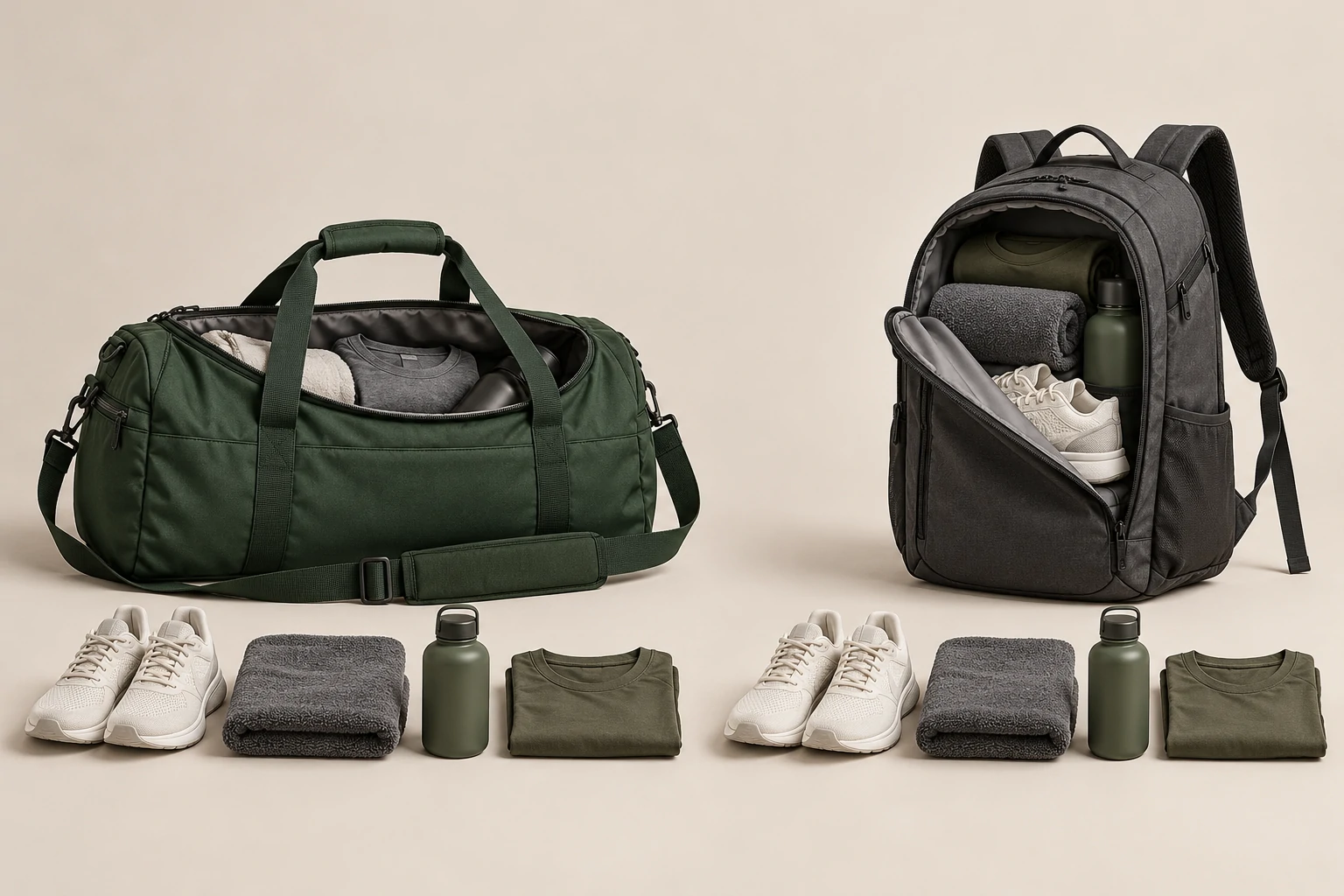
Duffel Bag vs Backpack Comparison
| Category | Duffel Bag | Backpack | Better starting choice |
|---|---|---|---|
| Large equipment capacity | Excellent | Moderate | Duffel |
| Walking comfort | Moderate | Excellent | Backpack |
| Cycling | Poor to moderate | Excellent | Backpack |
| Car-to-gym use | Excellent | Good | Duffel |
| Public transport | Moderate | Excellent | Backpack |
| Wide gear access | Excellent | Moderate | Duffel |
| Small-item organization | Good | Excellent | Backpack |
| Team sports | Excellent | Good for lighter kits | Duffel |
The correct answer depends more on movement and equipment than on style. A backpack is generally better for a commuter because the load stays close and both hands remain free. A duffel can be better for the same athlete when the kit includes bulky footwear, layers, and equipment that must be accessed quickly after a short walk from a vehicle.
Which Bag Has More Storage?
Capacity depends on the actual dimensions and construction, not the bag name. A 40 L backpack and a 40 L duffel may feel very different when packed. Backpack padding, a laptop sleeve, shaped panels, and several dividers use part of the internal volume. A duffel often provides a larger uninterrupted cavity, so the same nominal capacity can be more forgiving for shoes, protective gear, or a ball.
| Approximate capacity | Typical sports use |
|---|---|
| 15–25 L | Light workouts and minimal equipment |
| 25–35 L | Daily gym sessions and commuting |
| 35–50 L | Gym, court sports, and general training |
| 50–70 L | Team sports and bulky equipment |
| 70 L+ | Large equipment loads and team travel |
Liters are a useful starting point, not a guarantee of practical storage. Compare the main opening, shoe-compartment footprint, and the dimensions of the largest item the user carries. That gives a more realistic view of sports bag capacity than a number alone.
Which Is More Comfortable to Carry?
A backpack is generally more practical for longer carrying because two shoulder straps distribute a load and keep it near the body. That is useful when walking several blocks, climbing stairs, cycling, changing trains, or navigating an airport. This is not a claim that one style prevents injury; comfort changes with load weight, strap fit, body movement, and carrying time.
A duffel remains a sensible choice when it spends most of its journey in a car, on a team bus, or beside a court. Athletes who set the bag down often may value a wide opening more than all-day carry comfort. The best sports bag should match the route as well as the gear.
Practical rule
| Backpack usually works better when | Duffel usually works better when |
|---|---|
| You walk, cycle, commute, or need both hands free. | Equipment travels mainly by vehicle, walks are short, or bulky gear dominates the load. |
Which Bag Is Easier to Organize?
Organization and access are related but not identical. Backpacks usually offer more individual pockets, so a phone, keys, wallet, headphones, bottle, documents, laptop, and small training accessories each have a defined place. This makes them efficient for a day that mixes work, school, and training.
Duffels make the entire load easier to reach. Shoes, clothing, towels, balls, gloves, protective equipment, and uniforms can be loaded or removed without digging through vertical layers. A high-quality sports duffel can still organize well with end pockets, internal mesh pockets, shoe tunnels, wet pockets, and removable dividers.
Pack by item type
- Backpack: small electronics, documents, bottle, personal items, and compact accessories.
- Duffel: footwear, clothing, towels, balls, gloves, pads, uniforms, and larger accessories.
Shoe and Wet Gear Storage
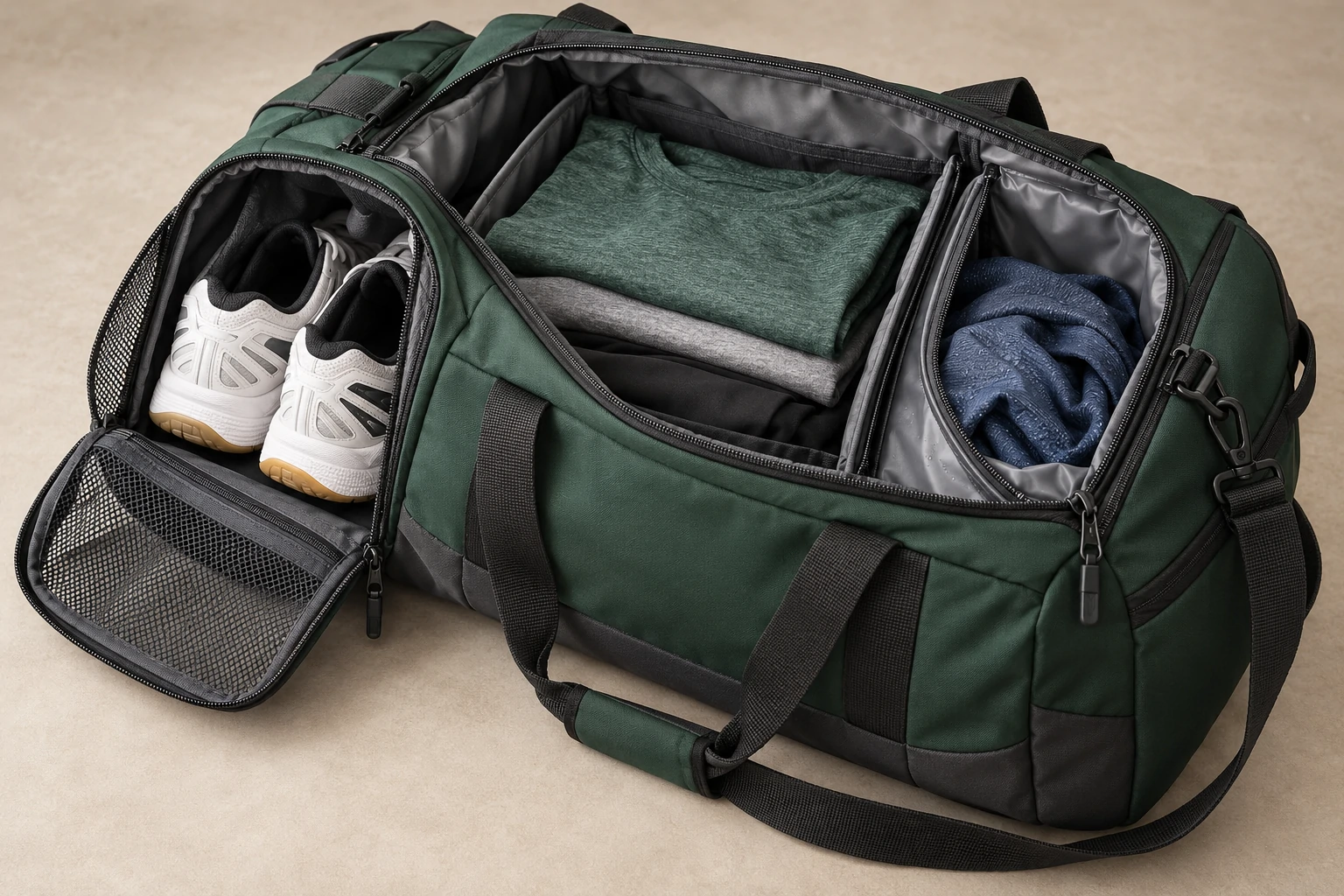
Sports bags work harder when they can separate dirty shoes, sweaty clothing, wet towels, clean garments, electronics, and personal items. A dedicated shoe compartment is useful only when it does not consume too much of the main compartment. Ventilation can help reduce trapped odor and moisture, while an easy-clean lining makes routine maintenance simpler.
For swimmers or athletes carrying heavily damp gear, a separate waterproof pouch or dry bag can add a reliable extra barrier. Water-resistant outer fabric helps with light exposure, but it does not replace internal wet/dry separation when wet equipment is packed with clean clothes.
Feature checklist
- Separate shoe compartment
- Washable or easy-clean lining
- Ventilation or breathable panels where appropriate
- Wet/dry separation and water-resistant materials
- Durable zipper construction and strong handle attachments
Duffel Bag vs Backpack by Sport
| Sport or activity | Recommended format | Main reason |
|---|---|---|
| General gym | Duffel or backpack | Depends on commute |
| Weight training | Duffel | Space for shoes, belt, and accessories |
| Running | Backpack | Compact, hands-free transport |
| Cycling to gym | Backpack | Stable hands-free carry |
| Basketball / football / volleyball | Duffel | Shoes, clothing, and team equipment |
| Swimming | Backpack or duffel | Wet/dry organization matters most |
| Tennis / badminton | Sport-specific bag or backpack | Racket protection determines format |
| Boxing / martial arts | Duffel | Gloves and protective gear are bulky |
| Yoga / Pilates | Light duffel or backpack | Limited equipment |
Sport-specific equipment can override a general duffel bag vs backpack recommendation. In racket sports, for example, racket protection and length are more important than the simple format label. For a team player, the amount of footwear and protective equipment may matter more than the preferred carrying style.
Duffel Bag vs Backpack for the Gym
For most gym users, both formats work well. The deciding factor is usually how you travel to the gym and how much equipment you carry. A gym duffel prioritizes capacity and access. A gym backpack prioritizes mobility, everyday organization, and hands-free transport.
| Choose a gym duffel if you carry | Choose a gym backpack if you |
|---|---|
| Training shoes, lifting shoes, a belt, knee sleeves, towel, clothing change, toiletries, or large accessories. | Walk, cycle, use buses or trains, go directly from work or school, carry a laptop, or prefer hands-free transport. |
Which Is Better for Team Sports?
Duffels are common in team sports because a player may carry a uniform, warm layers, footwear, towels, pads, and larger accessories at the same time. The broad opening also works well in busy changing rooms, where several items must be found quickly. Larger exterior panels can give clubs practical room for a logo, player number, sponsor mark, or team identification.
That does not make a backpack unsuitable. Youth players, coaches, referees, and athletes bringing a lighter training kit may prefer a backpack, especially if they cycle or take public transport. The equipment list should decide the format.
Which Is Better for Commuting?
Backpacks usually have the advantage for sports commuters. Dual straps, a smaller footprint, and hands-free movement make a backpack easier to manage through stations, buses, stairs, and crowded sidewalks. A laptop sleeve and small-item organization also make it natural for work-to-gym or school-to-training routines.
A convertible sports bag can bridge the difference. It combines duffel handles and backpack straps, so the carrier can use the mode that suits the route. A regular duffel is still practical for routes that are mainly home to car to gym, or hotel to team bus to venue.
Commuter checklist
- Choose a backpack: walking, cycling, stairs, trains, buses, airports, or multiple transfers.
- Choose a duffel: home → car → gym, hotel → team bus → venue, or parking area → sports facility.
Materials Matter More Than Bag Shape
Choosing between a duffel and backpack should not distract from construction quality. Polyester, nylon, recycled polyester, TPU-coated fabrics, tarpaulin, and mesh each have useful roles. Material selection depends on target price, abrasion needs, bag weight, water resistance, printing requirements, appearance, and sustainability objectives. No fabric is universally superior.
Fabric denier is only one consideration. A higher number alone does not guarantee a better bag; weave, coating, reinforcement, stitching, and hardware influence service life as well. For any sports bag, inspect the bottom panel, stress points, webbing, zipper system, handle attachment, and shoulder-strap hardware alongside the fabric.
Sports bag material checklist
- Reinforced stress points and bottom panel
- Quality webbing and reliable zipper systems
- Easy-clean interior and suitable water-resistant treatment
- Strong handle attachment and shoulder-strap hardware
What Size Sports Bag Do You Need?
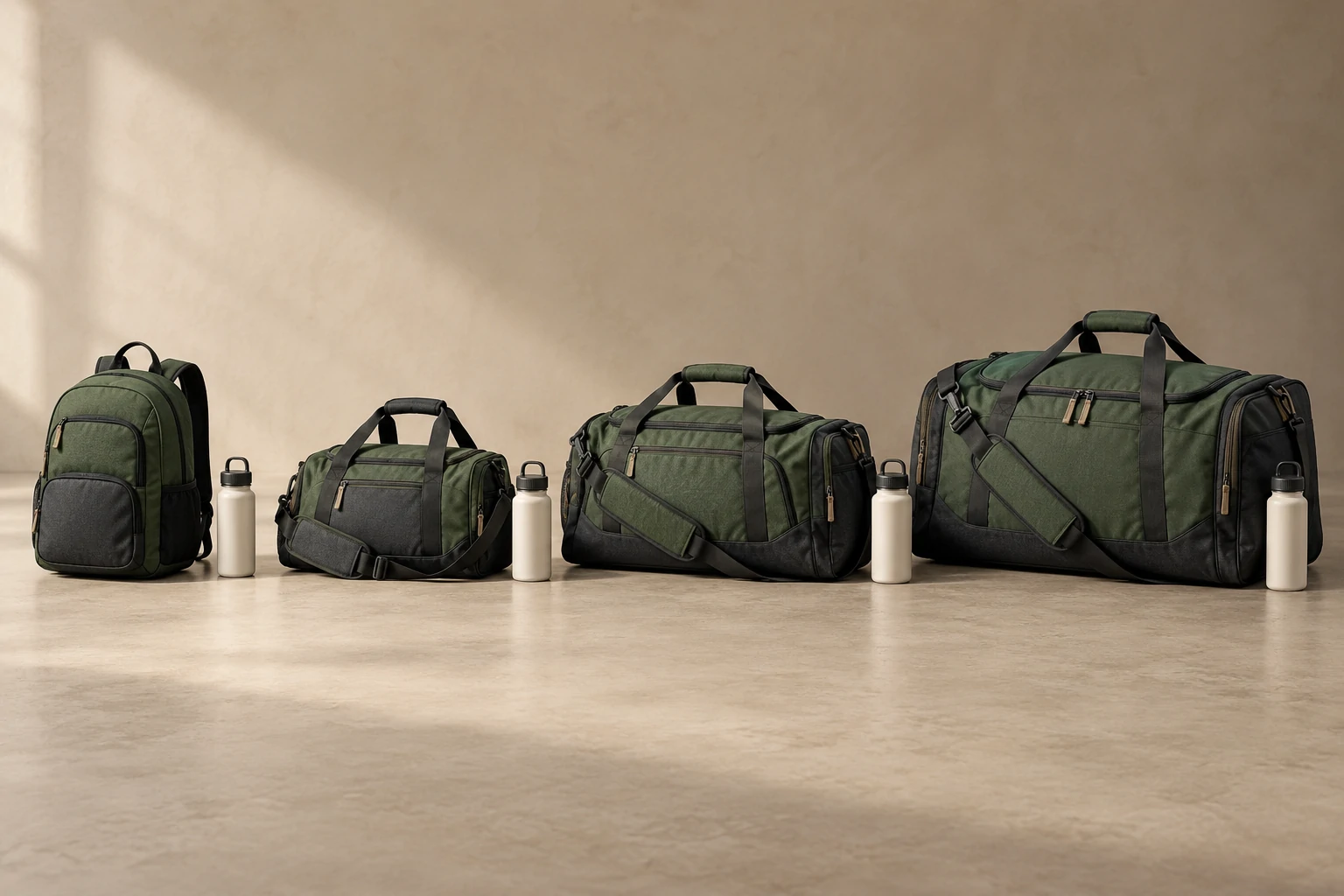
| Training type | Starting capacity | Suitable contents |
|---|---|---|
| Light training | 15–25 L | Shirt, shorts, small towel, bottle, small accessories |
| Daily gym use | 25–40 L | Shoes, clothing change, towel, bottle, toiletries |
| Equipment-heavy training | 40–60 L | Multiple shoes, protective equipment, accessories, larger towels |
| Team and bulky equipment | 50–70 L+ | Uniforms, footwear, pads, gloves, and multiple clothing layers |
Buyers should measure actual equipment instead of selecting a bag only by advertised capacity. The length of a racket, the depth of a shoe compartment, or the shape of protective gear can determine suitability before liters do.
How to Choose Between a Duffel Bag and Backpack
| Choose a duffel bag if | Choose a backpack if | Choose a convertible bag if |
|---|---|---|
| You carry bulky equipment, need a wide opening, want fast locker-room access, carry wet clothing, or mostly travel by car. | You walk significant distances, use public transport, cycle, carry work items, or value small-item organization. | Your transport method changes often, you travel for sport, or you need both backpack straps and duffel handles. |
B2B Considerations for Sports Bag Buyers
A B2B buyer should choose a duffel or backpack based on the intended end user rather than personal preference. An assortment for a fitness brand can use both formats, while a club program may need medium and large duffels. A retailer can cover more use cases by matching distinct models to commuting, court sports, team sports, and equipment-heavy training.
| Target customer | Suitable direction |
|---|---|
| Gym chains | Duffels and commuter backpacks |
| Fitness brands | Both formats |
| Team sports clubs | Medium and large duffels |
| Corporate fitness programs | Compact backpacks or duffels |
| Schools | Backpacks and team duffels |
| Racket sports brands | Sport-specific backpacks and racket bags |
| Outdoor fitness brands | Backpacks and convertible bags |
| Sports retailers | Mixed assortment |
Before development, define the target sport, equipment dimensions, capacity, intended retail price, material, compartments, shoe and wet/dry storage, logo method, color direction, zipper and webbing specifications, carrying method, packaging, and expected order quantity. These decisions shape a functional brief without relying on unproven claims or rigid production assumptions.
Final Decision Table
| Your priority | Best starting choice |
|---|---|
| Maximum flexible storage | Duffel bag |
| Long walking distance or cycling | Backpack |
| Public transportation | Backpack |
| Large shoes and equipment | Duffel bag |
| Quick locker-room access | Duffel bag |
| Work and gym combined | Backpack |
| Team sports | Duffel bag |
| Travel versatility | Convertible bag |
There is no universal winner in the duffel bag vs backpack comparison. Duffel bags are generally better for high-volume sports equipment and fast access, while backpacks are generally better for mobility, commuting, and extended carrying. The best sports bag is the one that matches the athlete's equipment and transportation routine.
FAQ
Duffel Bag vs Backpack FAQ
Short, practical answers for gym users, athletes, clubs, and sports bag buyers.
Is a duffel bag or backpack better for the gym?
Neither is universally better. A duffel is usually more convenient for bulky shoes, towels, clothing, and lifting accessories. A backpack is generally more convenient for people walking, cycling, or commuting by public transportation. Compare the travel route with the equipment list before deciding.
Is a backpack better than a duffel bag for your shoulders?
A backpack distributes a moderate load across two shoulder straps, which can make it more comfortable for longer carrying periods. A duffel can still be practical when the load is carried only a short distance or frequently set down. Fit, load, strap design, and carrying time all affect comfort.
Which holds more, a duffel bag or backpack?
Capacity depends on the model dimensions. Duffels often offer more uninterrupted usable space, while backpack padding, structured panels, and organizers can consume internal volume. Compare the dimensions of the largest item, not only the liters printed on the product.
Are duffel bags good for sports?
Yes. Their wide openings and flexible storage make them useful for gym training, basketball, football, volleyball, boxing, martial arts, and team sports. A duffel is especially useful when footwear, uniforms, towels, and protective equipment need quick access.
Are backpacks good for sports?
Yes. Sports backpacks work well for gym commuters, runners, cyclists, students, coaches, and athletes carrying moderate amounts of equipment. Look for a stable harness, bottle pocket, sufficient main volume, and shoe or wet storage when those features match the activity.
What size duffel bag is best for sports?
For lighter gym use, 25–40 L is often a useful starting range. General sports loads may need 40–60 L, while bulky team equipment may need 50–70 L or more. Required dimensions and compartment layout matter more than capacity alone.
Can a backpack be used as a gym bag?
Yes. Choose a gym backpack with enough room for your change of clothes and shoes. A washable lining, bottle pocket, wet compartment, ventilation, and separated shoe storage can be worthwhile when the workout routine includes sweaty clothing or damp gear.
Is a duffel bag better for team sports?
Often, yes. Team athletes commonly carry footwear, uniforms, towels, layers, and protective accessories, and a duffel gives those items flexible space. Backpacks remain practical for lighter training sessions, youth players, coaches, or athletes who commute by bicycle or transit.
What is a convertible duffel backpack?
A convertible duffel backpack combines traditional duffel handles with backpack straps. It can suit athletes and travelers who alternate between vehicle transport and walking. The design is useful only when both carrying modes are functional and do not unnecessarily reduce usable storage.
What should I look for in a sports bag?
Start with suitable capacity, durable fabric, strong zippers, reinforced handles, comfortable straps, shoe separation, wet/dry organization, easy-clean lining, appropriate pockets, and reliable stitching. Then assess whether the bag suits the user's sport, equipment dimensions, and transport routine.
Conclusion
Duffel Bag or Backpack: Which Should You Choose?
The decision is mainly about equipment and movement. A duffel bag is usually the better starting point when athletes need flexible space, bulky-equipment storage, shoe separation, wet/dry organization, and fast access. A backpack is usually the better starting point when hands-free transportation, cycling, public transit, longer walks, and organized everyday carry matter more.
Construction quality, compartment design, and correct capacity ultimately matter more than the name of the bag category. For sports brands, retailers, clubs, and distributors developing a collection, the strongest approach is often not selecting one universal format, but matching each format to a sport, equipment load, and transportation scenario.
- Duffel = capacity + access
- Backpack = mobility + carry comfort
- Convertible = flexibility
Project inquiry
Discuss Your Sports Bag Project
As an experienced sports and racquet bag manufacturer, Racquet Bag provides end-to-end OEM and ODM production for international sports brands and clubs. Whether your collection requires high-capacity custom tennis duffel bags, ergonomic tennis backpacks, or court-ready pickleball backpacks, our factory supports low MOQ wholesale manufacturing, custom Pantone color matching, and rapid 5-7 day physical sampling. Contact our bag engineering team to discuss tech packs and wholesale pricing.